
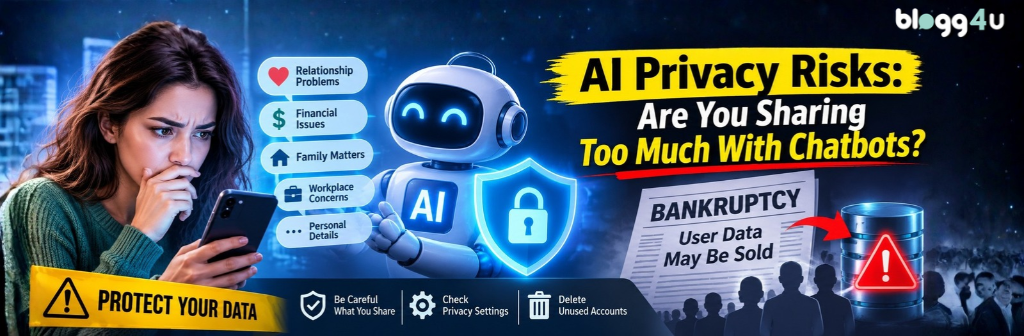
AI Privacy Risks: Are You Sharing Too Much With Chatbots?
Artificial intelligence has become part of our everyday lives. We use AI chatbots to write emails, solve problems, get career advice and even discuss personal issues.
But have you ever wondered what happens to the information you share with AI?
Think about it. You might discuss your financial problems, relationship struggles, workplace issues or family matters with a chatbot. It feels like a private conversation, but the information you share is handled by a technology company.
And what happens if that company goes bankrupt?
This is a growing concern as the AI industry expands, and it raises an important question: Could your private AI conversations become someone else’s business asset?
Let’s understand.
Why Do People Share Personal Information With AI?
Unlike traditional search engines, AI chatbots allow people to have detailed conversations.
You can explain a personal problem, ask follow-up questions and receive responses without feeling judged.
As a result, people sometimes share information they would not normally discuss publicly.
This could include:
- Personal and relationship problems.
- Financial and career-related information.
- Family matters and emotional struggles.
- Workplace documents and business information.
- Private details about friends and colleagues.
According to an October 2026 OECD report, the conversational nature of AI chatbots can encourage people to share more personal information than they intend.
The concern is that users may not fully understand how their conversations are stored or used.
What Happens If an AI Company Goes Bankrupt?
Here’s where things get interesting.
When a company faces bankruptcy, its assets may be sold or transferred to repay creditors or support a restructuring.
These assets can include technology, intellectual property and customer databases.
Depending on applicable laws and privacy policies, user data may also be involved in such transactions.
This means information you shared with an AI platform could potentially be accessed by another business under certain circumstances.
It doesn’t mean every AI company will sell its users’ conversations. However, it highlights a privacy risk that many users rarely consider.
Character.AI: A Real-World Example
One example is Character.AI, a platform that allows users to interact with AI-generated characters and virtual companions.
The platform became popular among people looking for entertainment, conversations and digital companionship, including younger users.
In October 2026, Character.AI filed for bankruptcy protection and agreed to a proposed $20 million deal with Disney for certain technology assets.
Importantly, user data was not included in the Disney deal.
However, bankruptcy court filings raised the possibility of user data being sold separately. The situation also attracted attention from 40 US state attorneys general, who sought stronger protections for children’s information.
This case highlights an important issue: what happens to sensitive conversations when the company storing them faces financial trouble?
Could The AI Bubble Make Things Worse?
AI companies are investing heavily in developing advanced technology. But building and operating AI systems is expensive.
Companies need:
- Powerful GPUs and computing infrastructure.
- Large data centres and electricity.
- Skilled engineers and AI researchers.
- Continuous investment in product development.
The challenge is that attracting millions of users doesn’t automatically make a company profitable.
If the AI industry experiences a major financial correction, some startups could struggle to survive. Others might merge, restructure or shut down.
Their accumulated user data could then become a valuable business asset.
The concern isn’t that AI will disappear. It’s that companies holding sensitive user information may not always survive.
You Don’t Even Have to Use AI to Be Affected
Here’s something many people overlook.
Suppose you never use an AI chatbot, but your friend discusses your personal problems with one.
They might share details about your family, relationships or workplace while asking the chatbot for advice.
Your information could become part of that conversation without your knowledge.
This makes AI privacy a concern beyond individual users. It also affects people whose personal details are shared by others.
Children and teenagers are particularly vulnerable because they may not fully understand the consequences of sharing private information with AI companions.
How Can You Protect Your Information When Using AI?
You don’t need to stop using AI. You just need to be careful about what you share.
Here are five simple precautions:
- Avoid sharing sensitive information: Never casually enter passwords, banking details, government identification numbers or confidential documents into AI chatbots.
- Check privacy settings: Understand whether your conversations can be used for AI training and whether you can opt out.
- Read the privacy policy: Check how your information is collected, stored, retained and shared, including during business transfers.
- Delete unused accounts: If you no longer use an AI platform, check whether you can request account and data deletion.
- Avoid sharing other people’s private details: Remove names and identifying information when asking AI for advice about someone else.
Remember, turning off model training does not necessarily mean your conversations are no longer stored.
Should You Trust AI With Your Secrets?
Artificial intelligence is making life easier, but convenience should not come at the cost of privacy.
The growing AI industry has created new questions about data ownership, security and corporate responsibility. The Character.AI case is a reminder that the companies holding our information may face financial difficulties, just like any other business.
You don’t have to stop using AI. Just think twice before sharing something deeply personal.
Because the smartest way to use AI isn’t just knowing what it can do. It’s understanding what you should never share with it.
At Blogg4U, we bring you closer to the technology shaping our world, helping you stay informed about both its opportunities and its risks.