
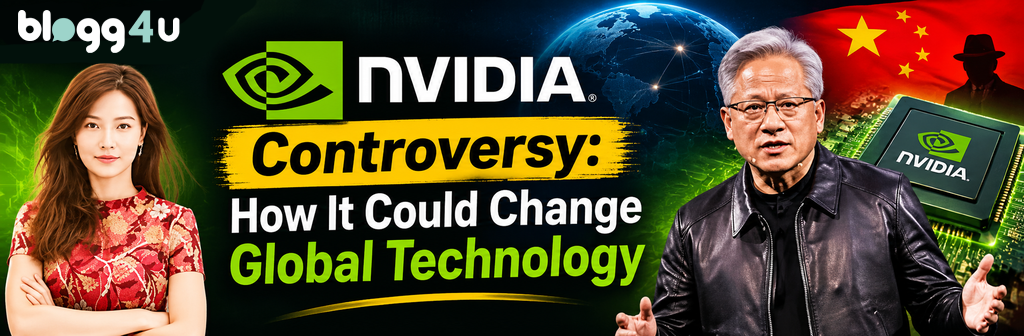
The technology industry is built on innovation, competition, and trust. But what happens when questions about trust emerge around one of the most influential companies in the world?
That is exactly what is happening with NVIDIA.
NVIDIA, a company whose chips power artificial intelligence systems, data centres, supercomputers, and several other advanced technologies, has found itself at the centre of an international controversy involving its CEO, Jensen Huang, allegations of Chinese espionage, and concerns about semiconductor exports.
What makes this situation particularly important is that it extends beyond the company’s leadership. It raises questions about how technology moves across international borders, how businesses protect sensitive information, and how much influence geopolitical tensions can have on the global economy.
But is there anything positive that could come out of this controversy? Or could it create more problems for the technology industry?
Let’s understand the situation and examine its possible consequences.
What Is the NVIDIA Controversy Actually About?
The controversy centres on Jensen Huang, NVIDIA’s founder and CEO, and his reported relationship with Alice Huang, a Chinese businesswoman who is not related to him.
According to media reports citing US intelligence assessments, Alice Huang was suspected of gathering information for the Chinese government. She was associated with Megaspeed International, a Singapore-based cloud computing company that has business connections with NVIDIA.
The company has also faced scrutiny over suspicions that advanced NVIDIA chips may have reached Chinese customers despite US export restrictions.
Reports about Jensen Huang’s relationship with Alice Huang raised concerns about whether foreign intelligence operations could have targeted the NVIDIA CEO to gain access to sensitive business information.
Huang acknowledged an extramarital relationship and apologised to his family and NVIDIA employees. However, he has not admitted to knowingly participating in espionage.
On November 8, 2026, NVIDIA’s board announced an independent investigation into the allegations. The company stated that it had no reason to believe its trade secrets or US national-security information had been compromised.
The situation escalated further on November 9 when a shareholder filed a proposed class-action lawsuit against NVIDIA and Huang, alleging that investors had not been properly informed about potential business and reputational risks.
It is important to understand that these remain allegations and the legal proceedings have not established wrongdoing.
Why Does the NVIDIA Case Matter to the Entire World?
To understand the potential impact, we first need to understand NVIDIA’s position in the global technology ecosystem.
NVIDIA is not just another chip manufacturer. Its graphics processing units (GPUs) are essential for training and running many modern AI systems.
From cloud computing platforms and autonomous technologies to scientific research and generative AI, NVIDIA’s hardware plays an important role in the infrastructure behind today’s digital economy.
Consequently, any major disruption involving the company could have implications far beyond its shareholders.
Here are five major areas where the controversy could influence the world.
1. The Global AI Industry Could Face Greater Security Restrictions
One of the biggest possible consequences is increased scrutiny of AI technology and semiconductor exports.
The United States already maintains restrictions on exporting certain advanced computing chips to China because of national-security concerns.
If investigations reveal weaknesses in existing supply-chain controls, governments could introduce stricter procedures for monitoring chip distribution, verifying customers, and tracking where advanced computing hardware ultimately goes.
The possible benefit:
Stronger security measures could make it harder for restricted technology to reach unauthorised buyers. This could encourage technology companies to improve their internal security systems, customer verification processes, and supply-chain transparency. It may also push governments and businesses to take intellectual property protection more seriously.
The possible downside:
Stricter restrictions could make it more difficult for legitimate international businesses to access advanced computing hardware. AI startups, research institutions, cloud providers, and smaller technology companies could face higher costs and longer waiting periods. In other words, better security could come at the cost of slower technological accessibility.
2. US-China Technology Relations Could Become More Complicated
The NVIDIA controversy arrives at a time when the United States and China are already competing for leadership in artificial intelligence, semiconductors, and advanced computing.
Both countries understand that access to powerful computing infrastructure can influence their economic and technological future.
If the allegations lead to further investigations or export-control measures, tensions between the two countries could increase.
The possible benefit:
This situation could encourage countries to invest more heavily in their own semiconductor industries. Governments may increase funding for domestic chip manufacturing, AI research, and technology infrastructure rather than depending heavily on foreign suppliers. Over time, this could create more competition in the semiconductor market.
The possible downside:
A more divided technology ecosystem could emerge. Instead of companies freely working across international markets, businesses might have to operate under different technology standards, export regulations, and geopolitical restrictions. This could make international collaboration more difficult and increase the cost of developing new technologies.
3. Investors Could Become More Careful About Technology Companies
NVIDIA’s stock market reaction demonstrates how quickly uncertainty surrounding a major technology company can influence investor confidence.
According to Reuters, NVIDIA lost approximately $430 billion in market value over two trading sessions amid growing scrutiny of the controversy.
The shareholder lawsuit also raises questions about corporate disclosure, executive accountability, and how companies communicate material risks to investors.
The possible benefit:
Investors may begin paying closer attention to corporate governance rather than evaluating technology companies solely on revenue, profitability, and future growth. Boards could face greater pressure to establish independent oversight, stronger risk-management practices, and clearer disclosure policies. This could encourage healthier business practices across the technology industry.
The possible downside:
Uncertainty can create sudden market volatility. Even companies with strong financial performance may experience declining investor confidence when leadership or national-security concerns emerge. This can affect shareholders, institutional investors, retirement funds, and businesses that depend on stable market conditions. It could also make investors more cautious about funding companies operating in politically sensitive technology sectors.
4. Global Businesses Could Face Higher AI and Technology Costs
This is where the controversy could eventually affect businesses and everyday consumers.
Many companies depend on AI infrastructure to operate their products and services. Cloud computing providers, software companies, financial institutions, healthcare technology businesses, and e-commerce platforms all use computing resources to improve their operations.
If semiconductor restrictions become stricter or chip distribution becomes more complicated, the availability and cost of computing infrastructure could change.
The possible benefit:
Businesses may start diversifying their technology suppliers instead of relying heavily on a single manufacturer. This could encourage investment in alternative semiconductor companies, more efficient AI chips, and locally developed computing infrastructure. Greater competition could eventually improve product availability and create more choices for businesses.
The possible downside:
Developing alternative infrastructure takes time and money. If access to advanced GPUs becomes more expensive or restricted, businesses may have to spend more on AI development. Smaller companies and startups could be affected more severely because they often have limited budgets for computing infrastructure. Ultimately, higher infrastructure costs could translate into more expensive AI-powered products and services.
5. Countries Like India Could Find New Technology Opportunities
Although the controversy is centred around NVIDIA and US-China relations, its consequences could create opportunities for other countries.
India, for example, has been working towards strengthening its semiconductor manufacturing ecosystem and expanding its artificial intelligence capabilities.
If global businesses begin diversifying their technology supply chains, countries with growing semiconductor ambitions could attract more investment.
The possible benefit:
India could benefit from increased interest in semiconductor manufacturing, electronics production, chip design, data centres, and AI infrastructure. It could also create opportunities for Indian technology companies, engineers, startups, and research institutions. A stronger domestic technology ecosystem could reduce dependence on international suppliers over the long term.
The possible downside:
Building a competitive semiconductor industry is not easy. It requires substantial capital investment, specialised talent, advanced manufacturing equipment, reliable infrastructure, and long-term policy support. If global technology markets become more divided, Indian businesses may also face complicated export regulations and supply-chain challenges. Therefore, the opportunity is significant, but it is not an automatic benefit.
Could There Be Any Positive Outcome From the NVIDIA Controversy?
Interestingly, yes.
Although the controversy itself is not good news for the technology industry, the issues it has brought into focus could encourage meaningful improvements.
Here are some possible long-term benefits:
- Stronger corporate governance: Technology companies may introduce more independent oversight and stricter executive accountability.
- Better cybersecurity: Companies could strengthen their protection against corporate espionage, insider threats, and foreign intelligence operations.
- More semiconductor competition: Countries and businesses may invest in alternative chip technologies and manufacturing capabilities.
- Improved supply-chain transparency: Hardware manufacturers may introduce better customer verification and distribution tracking.
- Reduced technology dependence: Governments may accelerate domestic semiconductor and AI infrastructure development.
These improvements could make the global technology industry more resilient.
However, they will only be meaningful if governments and companies respond with practical security improvements rather than simply introducing more restrictions.
What Could Go Wrong If the Situation Escalates?
The biggest concern is that the controversy could become another reason for countries to strengthen technology barriers against one another.
If investigations lead to broader restrictions on semiconductor exports, the consequences could extend to companies that have no direct connection with NVIDIA.
A prolonged escalation could create several challenges:
- Higher prices for advanced computing hardware.
- Delays in AI research and product development.
- Increased uncertainty for international technology investors.
- More complicated relationships between global technology suppliers and customers.
- Greater competition between countries to control critical semiconductor resources.
The biggest risk is that security concerns could gradually turn into long-term economic and technological divisions.
What Happens Next for NVIDIA and the Global Technology Industry?
As of November 11, 2026, NVIDIA’s independent board investigation is underway, and the company and Jensen Huang face a proposed shareholder class action.
US authorities are also examining potential export-control concerns involving Megaspeed.
The coming weeks could be important in determining whether the controversy remains primarily a corporate governance issue or develops into a much larger national-security and international trade matter.
Some important questions remain unanswered:
- Did the alleged foreign intelligence operation gain access to any sensitive information?
- Were NVIDIA’s internal security and customer verification procedures adequate?
- Did the company adequately communicate potential risks to its investors?
- Will the US government introduce additional semiconductor export restrictions?
- Could the controversy affect NVIDIA’s leadership and long-term business relationships?
The answers could influence how technology companies approach international business, executive security, and geopolitical risk management.
Is This a Crisis or an Opportunity for the Technology Industry?
The NVIDIA controversy is a reminder that the future of technology is not determined by innovation alone.
It also depends on trust, security, international cooperation, responsible leadership, and transparent business practices.
There could be positive outcomes if the situation encourages better corporate governance, stronger cybersecurity, and more competitive semiconductor ecosystems.
However, the consequences could be considerably more damaging if the controversy intensifies existing geopolitical tensions and creates further barriers to international technology development.
For businesses, investors, and consumers, the most important thing to watch is not simply what happens to NVIDIA’s stock price or whether Jensen Huang remains CEO.
It is whether this situation changes how the world builds, distributes, protects, and accesses the technology powering its future.
Because the real question is no longer just about NVIDIA. It is about who controls the technology that will shape the next generation of the global economy.