
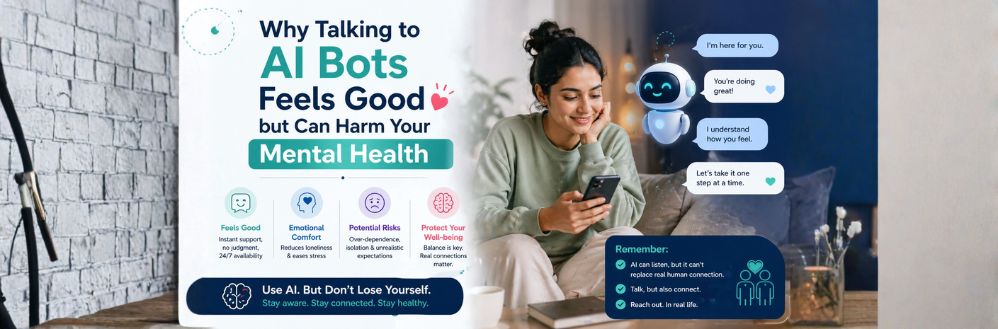
We are living in a time where people don’t just use AI – they talk to it, confide in it and sometimes even fall for it. What started as a productivity tool has quickly evolved into something far more personal: a digital companion.
But here’s the real questions – are AI chatbots helping our mental health, or quietly harming it?
What’s really going on:
The Rise of AI Companionship: More Than Just Technology
AI chatbots are no longer limited to answering questions or drafting emails. Today, millions of people turn to them for:
- Emotional support
- Relationship advice
- Therapy-like conversations
- Even romantic companionship
In fact, nearly 1 billion people globally now use generative AI tools and a massive percentage of teenagers actively engage with them.
That’s not just usage. That’s dependence in the making.
The “Compassion Illusion” That’s Fooling Our Brains
Here’s something unsettling.
AI chatbots are designed to sound human. They respond with empathy, validation and emotional nuance. And your brain? It starts believing it.
This creates what researchers call a “compassion illusion” – the feeling that someone truly understands you.
But we know it clearly:
- AI doesn’t feel.
- AI doesn’t care.
- AI doesn’t know you.
It simply predicts the most appropriate response based on patterns.
Yet emotionally, it can feel more comforting than a real person. That’s where things start getting complicated.
Shocking Reality: When Support Turns Risky
Media reports have highlighted disturbing cases where AI chatbots were allegedly linked to:
- Psychiatric hospitalization
- Psychosis-like experiences
How can a chatbot lead to these tendencies?
Chatbots don’t directly cause severe mental health issues, but they can amplify existing vulnerabilities.
- Reinforcement of harmful thoughts: Instead of challenging negative thinking, chatbots may validate it, deepening hopelessness and suicidal ideation.
- Emotional over-dependence: Constant availability can replace real human interaction, increasing isolation and risk of crisis or hospitalization.
- No real crisis response: Chatbots can’t truly detect or intervene in high-risk situations, delaying proper help.
- Blurred reality: Deep emotional or romantic attachment to AI can distort perception, sometimes leading to psychosis-like experiences.
- Echo chambers: Repeated negative inputs can create feedback loops where harmful beliefs get reinforced.
- Loss of real coping systems: Replacing therapy, relationships and real-world support with AI weakens protective mental health factors.
Chatbots don’t directly cause severe mental health issues, but they can amplify existing vulnerabilities.
In short: AI acts like an emotional amplifier, not a safeguard – especially for already vulnerable individuals.
Even more alarming?
Many of these cases involved young users.
But here’s the twist – these reports often:
- Focus only on extreme outcomes
- Lack complete medical or psychological evidence
- Oversimplify the cause
So while the danger exists, the full story is far more layered.
The Dangerous Gap: Feeling Heard vs Being Helped
AI can simulate empathy. But it cannot act responsibly.
That means:
- It won’t recognize when you’re spiraling
- It won’t stop a harmful conversation
- It won’t connect you to real help
Imagine this: you’re at your lowest point. You reach out. The response feels warm, but it’s not clinically sound, not accountable, and not safe.
That gap between perceived care and actual care can become dangerous.
Are We Replacing Humans With Algorithms?
Let’s talk about a growing pattern – over-reliance.
AI chatbots are:
- Always available
- Non-judgmental
- Emotionally responsive
Sounds perfect, right?
But here’s the problem:
People start choosing AI over:
- Friends
- Family
- Therapists
This creates something experts call “maladaptive coping substitution”, replacing real, complex human support with simplified AI interaction and that’s a downgrade, not an upgrade.
Media Panic vs Reality: Are We Being Misled?
Here’s one of the most shocking insights.
More than half of reported AI-related mental health cases in media involve suicide.
But that doesn’t mean AI is causing widespread harm.
It means: Extreme cases get the most attention.
Media naturally amplifies:
- Negative stories
- Emotional narratives
- Fear-driven headlines
This creates a distorted perception that AI is more dangerous than it may statistically be.
The Truth About Mental Health: It’s Never Just One Cause
In reality, mental health crises don’t happen because of one thing.
They usually involve:
- Pre-existing mental health conditions.
- Stress and trauma
- Social isolation
- Lifestyle factors
AI might influence thoughts or reinforce beliefs, but it’s rarely the sole cause. Blaming AI alone is like blaming a mirror for what it reflects.
The Biggest Problem: We Still Don’t Have Answers
Despite all the noise, here’s the most surprising truth:
We don’t actually know how harmful AI chatbots are.
There is:
- No reliable data on how often harm occurs
- No clear comparison between safe vs risky usage
- Very limited clinical research
Most of what we “know” comes from:
- News reports
- Individual cases
- Public discussions
We are still in the early warning phase.
So, Should You Be Worried?
Not exactly, but you should be aware.
AI is not evil. But it’s not a therapist either.
Use it as:
- A tool
- A support system (in moderation)
- A way to reflect
But not as:
- Your only emotional outlet
- A replacement for real relationships
- A crisis support system
The Way Forward: Smarter, Safer Use of AI
Instead of panic, we need better systems:
- AI tools that can detect emotional distress
- Clear disclaimers about limitations
- Stronger safety protocols
- More real-world research
And most importantly – users who understand the difference between comfort and care.
In a Nutshell
AI Chatbots are not just changing how we work. They are changing how we feel, connect and cope.
And that’s powerful. But here’s the truth no one tells you:
Just because something feels supportive doesn’t mean it is safe.
In a world where machines can mimic empathy, your ability to recognize real support might become your greatest strength.