
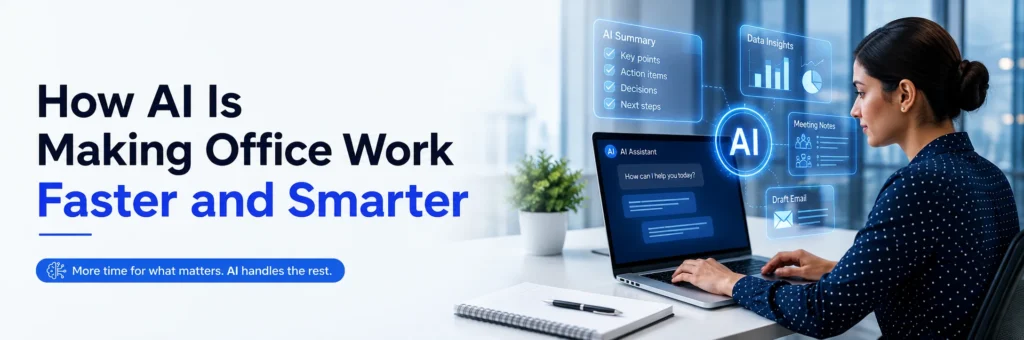
How AI Is Making Office Work Faster and Smarter
The modern workplace runs on speed, communication, and the ability to manage large amounts of information without losing focus. Yet many office workers spend a significant part of their day on repetitive activities such as answering emails, scheduling meetings, preparing reports, organizing documents, taking notes, and searching for information. Artificial intelligence (AI) is changing that equation.
Instead of replacing employees, AI is increasingly working alongside them as a digital assistant. It can handle routine tasks, organize information, generate first drafts, summarize lengthy content, analyze data, and help employees make decisions faster. As a result, workers can spend more time on activities that require creativity, judgment, communication, and problem-solving.
Research also supports the productivity potential of this shift. A study published in the Quarterly Journal of Economics examined more than 5,000 customer-support agents and found that access to a generative AI assistant increased productivity by about 15% on average. The gains were particularly significant among less-experienced workers.
AI Is Reducing the Burden of Repetitive Work
Repetitive tasks can quietly consume hours every week. An employee might spend the morning sorting emails, the afternoon updating spreadsheets, and the end of the day preparing routine reports. None of these activities necessarily require deep human judgment, but they still need time and attention.
AI can take over many of these routine processes.
For example, an AI assistant can categorize incoming emails, summarize long conversations, extract important information from documents, or create a first draft of a report. Employees can then review the output rather than starting everything from scratch.
This approach creates a simple but important change: AI handles more of the preparation, while people focus on the final decision.
That does not mean employees should accept every AI-generated result without checking it. Human review remains essential, particularly when information is sensitive, complex, or business-critical.
Faster Email and Communication Management
Email remains one of the biggest time-consuming activities in office environments. Workers often need to read lengthy threads, identify action points, draft responses, and follow up with different people.
AI can streamline each of these steps.
It can summarize an email thread into a few key points, identify deadlines, suggest responses, adjust the tone of a message, and highlight unanswered questions. Instead of spending several minutes understanding a long conversation, an employee can quickly review an AI-generated summary and decide what needs attention.
AI can also help employees communicate more clearly. Workers can use it to turn rough notes into professional messages, simplify complicated explanations, or adapt a message for different audiences.
The employee still controls the message. AI simply reduces the amount of time required to prepare it.
Smarter Meetings With AI
Meetings create another area where AI can make a noticeable difference.
AI-powered meeting tools can transcribe conversations, summarize discussions, identify important decisions, and create lists of action items. This means employees do not have to rely entirely on handwritten notes while participating in a discussion.
Imagine a one-hour meeting involving several team members. Instead of asking everyone to remember every detail, AI can create a structured summary that includes:
- Key discussion points
- Decisions that the team made
- Tasks assigned to individuals
- Important deadlines
- Questions that still require answers
Employees can then spend more time participating in the conversation instead of constantly taking notes.
This becomes particularly useful for teams that work remotely or across different time zones. A person who cannot attend a meeting can review the summary and understand what happened without watching the entire recording.
AI Is Making Data Analysis More Accessible
Office workers increasingly deal with spreadsheets, dashboards, reports, and business data. Traditionally, analyzing this information could require advanced spreadsheet skills or assistance from specialized teams.
AI is making basic data analysis more accessible.
Employees can ask AI tools to identify trends, compare figures, summarize datasets, explain unusual changes, or suggest ways to visualize information. A marketing employee, for example, can use AI to analyze campaign results, while a sales professional can ask it to identify patterns in customer data.
This does not eliminate the need for human analysis. Instead, it reduces the time employees spend finding patterns and preparing information, allowing them to focus on what those patterns actually mean for the business.
AI Helps Employees Create Content Faster
Writing is another area where office workers can benefit from AI.
Employees across departments regularly create emails, presentations, reports, proposals, social media content, product descriptions, internal announcements, and other documents. Starting with a blank page can take considerable time.
AI can provide a first draft based on a few instructions. Employees can then edit, fact-check, personalize, and improve that draft.
This process can significantly reduce the time required to produce routine content.
For example, instead of spending 30 minutes creating a basic internal announcement, an employee can provide the key information to an AI tool and receive a structured draft within seconds. The employee can then spend the saved time checking accuracy and making the message sound appropriate for the organization.
The value does not come from letting AI write everything. It comes from using AI to remove the friction of getting started.
AI Can Help Employees Find Information Faster
Large organizations often store information across emails, documents, presentations, spreadsheets, knowledge bases, and internal platforms. Finding one specific piece of information can become surprisingly difficult.
AI-powered search can make this process easier by allowing employees to ask questions in natural language rather than searching for exact keywords.
For instance, instead of manually searching through dozens of documents, an employee could ask an AI assistant to find the latest information about a particular project or summarize the relevant documents.
This can reduce the time employees spend looking for information and help them reach decisions faster.
AI Is Supporting Better Time Management
AI can also help employees organize their working day.
Modern AI assistants can identify priorities, summarize pending tasks, suggest schedules, and help employees plan their workload. Some systems can analyze calendars and communication patterns to help users identify time-consuming activities or protect periods for focused work.
This matters because productivity does not simply mean completing more tasks. It also means spending time on the tasks that create the most value.
Microsoft’s 2025 Work Trend Index found that 80% of the global workforce reported lacking enough time or energy to complete their work, while employees were interrupted by a meeting, email, or notification roughly every two minutes on average.
AI can help address part of this problem by reducing the amount of manual work that surrounds these interruptions.
AI Can Improve Productivity for New Employees
One of the more interesting benefits of AI involves employee learning.
New employees often need time to understand company processes, learn industry terminology, and develop the skills required to handle common situations. AI assistants can provide explanations, suggest approaches, and help workers understand unfamiliar tasks.
Research on customer-support workers found that AI assistance produced especially strong productivity improvements among less-experienced and lower-skilled employees. The researchers also found evidence that AI helped spread effective practices from more experienced workers to newer employees.
In practical terms,AI can act as an always-available learning companion. Employees can ask questions without interrupting a colleague every few minutes, which can make the learning process more efficient.
AI Is Shifting Employees Toward Higher-Value Work
The biggest change may not involve individual tasks at all. AI is gradually changing how employees spend their working hours.
When AI handles repetitive activities, employees can devote more attention to tasks that require uniquely human abilities. These include:
- Strategic thinking
- Creative problem-solving
- Negotiation
- Relationship building
- Leadership
- Critical thinking
- Complex decision-making
- Customer interaction
Microsoft’s 2025 Work Trend Index reported that 83% of business leaders surveyed expected AI to help employees take on more complex and strategic work earlier in their careers.
This suggests that the real opportunity lies in human-AI collaboration, rather than treating AI as a simple replacement for human workers.
The Efficiency Gains Are Real, But They Depend on How AI Is Used
AI does not automatically make every employee more productive.
The results depend on the task, the quality of the AI system, employee training, and the amount of human oversight involved. Workers must also understand the limitations of AI, including inaccurate information, outdated knowledge, biased outputs, and inappropriate recommendations.
NIST’s Human-Centered AI work emphasizes that generative AI can affect workplace tasks in both positive and negative ways and that organizations need to understand how employees use these systems.
For that reason, companies should establish clear guidelines around AI use. Employees need to know what information they can share with AI systems, when they must verify an output, and which decisions require human approval.
The Future of Office Work Will Be Human + AI
AI is not simply another productivity app. It is becoming part of the way people approach everyday work.
An employee who once spent an hour preparing a report may now spend 15 minutes reviewing an AI-generated draft. A manager can receive a meeting summary without going through an entire recording. A customer-support representative can receive real-time suggestions while speaking with a customer. A new employee can use AI to understand unfamiliar concepts without waiting for someone else to explain them.
These small improvements can add up to significant productivity gains across an organization.
The broader workplace is already moving in this direction. Microsoft’s 2025 Work Trend Index found that 82% of business leaders expected to use digital labor to expand workforce capacity within 12 to 18 months, while 46% said their organizations were already using AI agents to automate workstreams or business processes.
The goal, however, should not be to make employees work faster simply so they can handle even more tasks. The better goal is to remove unnecessary work and give people more time for meaningful work.
Conclusion
AI is helping office workers streamline their daily responsibilities by automating repetitive tasks, accelerating communication, simplifying data analysis, improving meeting management, supporting content creation, and making information easier to access.
The evidence suggests that these benefits can translate into measurable productivity improvements. But AI works best when employees remain actively involved. People provide context, judgment, creativity, accountability, and empathy – qualities that technology cannot simply replace.
The future office will therefore not be defined by humans versus AI. It will be defined by humans working smarter with AI.
When organizations introduce AI thoughtfully, train their employees, protect sensitive information, and keep humans responsible for important decisions, the technology can do more than save time. It can help employees focus their energy on the work that matters most.