
AI is getting better and better and harder to keep up with.
One minute, you’re hearing about a new chatbot. Next, there’s a new model that can research, code, analyze documents, use tools, and apparently handle work that once needed an entire afternoon.
Two names creating plenty of curiosity are GPT-6 Astra and Claude Fable 5.1.
Both are built for advanced AI work, but they aren’t simply two versions of the same thing. Their strengths, design philosophies, and ideal use cases can be quite different.
So, if you’re wondering what GPT-6 Astra, what is Claude Fable 5.1, and how are they different? Here’s a simple breakdown.
GPT-6 Astra vs Claude Fable 5.1: The Big Picture
The easiest way to understand the difference is to look beyond benchmark scores.
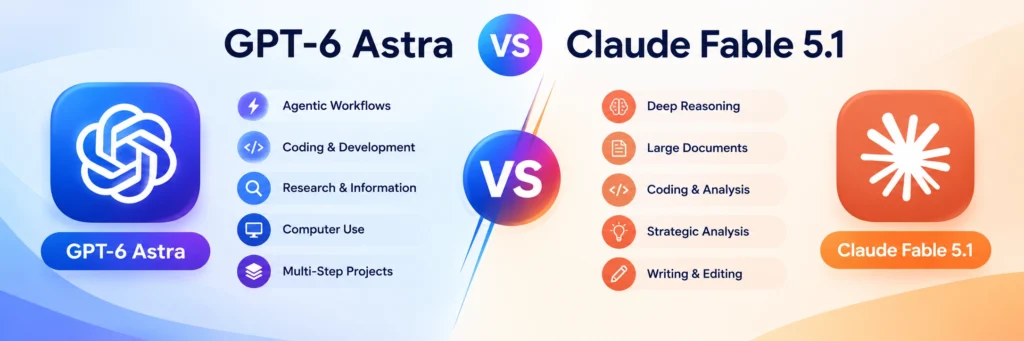
GPT-6 Astra is heavily focused on getting things done. It is designed for complex reasoning, research, coding, computer use, and multi-step workflows where an AI needs to move from an instruction toward an actual result.
Claude Fable 5.1, meanwhile, puts a strong emphasis on deep reasoning, coding, analysis, and knowledge work. It is particularly useful when the task requires understanding complicated information, examining an existing solution, and working through difficult problems carefully.
In other words, one useful way to think about them is:
- GPT-6 Astra: “Give me the goal, and I’ll work through the steps.”
- Claude Fable 5.1: “Give me the difficult problem, and I’ll think it through with you.”
What Makes GPT-6 Astra Different?
GPT-6 Astra represents a bigger shift toward AI agents rather than AI that simply responds to prompts.
Instead of only answering, an advanced agent can plan a task, use tools, interact with software, gather information, and work through multiple steps.
For example, imagine asking an AI to research several competitors, organize the findings, analyze the differences, and turn everything into a presentation. With a traditional chatbot, you might need to guide it through each stage. A model designed around agentic workflows can take much more responsibility for connecting those steps together.
That makes GPT-6 Astra particularly interesting for research, software development, data analysis, computer-based tasks, and long-running projects.
What Makes Claude Fable 5.1 Different?
Claude Fable 5.1 takes a slightly different route.
Its major appeal is its ability to handle complex reasoning and knowledge-intensive work. Instead of simply producing an answer quickly, it can spend more effort understanding the problem, examining context, and working toward a thoughtful solution.
This can be valuable when you’re dealing with:
- Large documents
- Complicated codebases
- Research-heavy projects
- Strategic analysis
- Technical writing
- Detailed editing and refinement
Think of it as having a very patient collaborator who is willing to sit with a complicated problem instead of immediately jumping to the first possible answer.
GPT-6 Astra vs Claude Fable 5.1: Which Is Better?
This is where things get interesting. There isn’t necessarily one winner for every task.
| Task | GPT-6 Astra | Claude Fable 5.1 |
|---|---|---|
| Complex Reasoning | Excellent | Excellent |
| Coding | Excellent | Excellent |
| Research | Excellent | Excellent |
| Computer Use | Strong focus | Strong |
| Long Documents | Excellent | Excellent |
| Strategic Analysis | Excellent | Excellent |
| Agentic Workflows | Major Strength | Major Strength |
| Writing & Editing | Excellent | Excellent |
The better choice depends heavily on what you actually want the AI to do.
If your workflow involves browsing, tools, software, research, and multiple connected actions, GPT-6 Astra’s agentic capabilities can be particularly attractive.
If you’re working through a complicated document, analyzing a difficult problem, reviewing code, or refining an existing piece of work, Claude Fable 5.1 can be a compelling choice.
Why Are These Models Such a Big Deal?
The bigger story isn’t really GPT-6 Astra vs Claude Fable 5.1. It’s the direction AI is moving in. Early AI tools were mostly about answering questions. Then came AI that could write, summarize, translate, generate images, and code.
Now, the focus is shifting toward AI that can reason, use tools, remember objectives, interact with software, and complete multi-step tasks.
That changes how people may eventually use AI at work. The AI isn’t just generating text anymore. It is becoming part of the workflow.
So, Which One Should You Use?
There’s no universal answer. For everyday users, the differences may not even matter for simple questions, brainstorming, or basic writing. But for professionals, developers, researchers, marketers, analysts, and businesses handling complex workflows, the distinction becomes much more important.
GPT-6 Astra may appeal more if you want an AI that can take an objective and work through multiple actions to accomplish it. Claude Fable 5.1 may appeal more if your priority is deep analysis, reasoning, coding and working carefully through complicated information.
You don’t necessarily have to choose one forever. AI is evolving quickly, and different models can be better suited to different jobs. The smartest approach may be to understand what each model does well and use the right tool for the task.
In a Gist
GPT-6 Astra and Claude Fable 5.1 represent the next stage of AI: less “ask a question and get an answer,” and more “give the AI a goal and let it help you accomplish it.”
The real competition isn’t just about who has the higher benchmark score. It’s about which AI can become the more useful partner for the work you actually need to get done.