
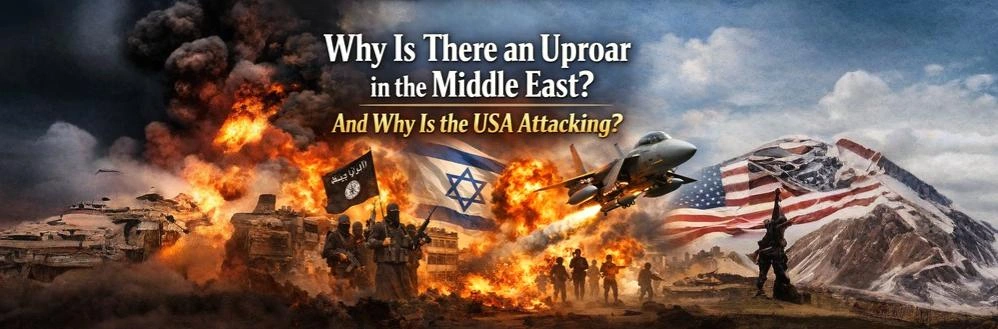
The Middle East is once again in global headlines. News channels show missiles, protests, military bases on high alert. And world leaders exchanging warnings. Many people are asking the same questions: Why is there so much tension in the Middle East and why is the USA involved in attacks?
In this blog, we will understand what is really happening.
Why the Middle East Is Always in Global Focus
The Middle East plays a powerful role in global politics for three main reasons:
Oil and Energy Power
Countries like Saudi Arabia, Iran, Iraq and the United Arab Emirates control a large share of the world’s oil reserves.
When conflicts happen, oil prices rise. When oil prices rise, petrol, transport and even food prices increase worldwide.
| The Middle East holds about 48% of the world’s proven oil reserves. Countries like Saudi Arabia, Iran, and Iraq play a major role in global fuel supply.Even a small conflict in the region can increase petrol prices worldwide within days. |
Religious and Historical Conflicts
The region holds deep religious importance. Cities like Jerusalem are sacred to Muslims, Christians and Jews.
For centuries, different groups have fought over land, power and identity. These tensions did not start yesterday. Many current conflicts trace back to decisions made after World War I, when Western powers divided territories without considering ethnic and religious differences.
Political Rivalries and Proxy Wars
Two major regional powers – Iran and Saudi Arabia compete for influence across the region.
They support opposite sides in conflicts in countries like:
- Yemen
- Syria
- Lebanon
Instead of fighting directly, they often fund and arm local groups. Experts call this a “proxy war.”
So Why Is There Uproar Right Now?
Current tension usually increases due to one or more of these triggers:
- Missile or drone attacks
- Attacks on military bases
- Assassinations of top leaders
- Airstrikes across borders
- Disputes involving Israel and Palestinian groups
When one side attacks, the other side responds. That response triggers another reaction. This cycle creates regional instability.
Social media also plays a role. News spreads instantly. Videos go viral. Public anger rises quickly. Protests begin across multiple countries.
Why Is the USA Involved in the Middle East?
Now comes the main question: Why is the United States attacking or getting involved?
The USA usually claims three key reasons:
Protecting Its Allies
The United States considers Israel a major ally. It also maintains strong ties with Saudi Arabia and the United Arab Emirates.
If these countries face attacks, the USA often responds to protect its strategic interests.
Protecting American Military Bases
The USA has military bases in countries like:
- Iraq
- Qatar
- Kuwait
If militias attack these bases, the US may launch retaliatory airstrikes.
| The US maintains one of its largest air bases in the Middle East at Al Udeid Air Base in Qatar. |
Countering Iran’s Influence
The USA and Iran have had tense relations since 1979, after the Iranian Revolution.
The killing of Iranian General Qasem Soleimani in 2020 by a US drone strike sharply increased tensions.
Since then, both sides have engaged indirectly through allied groups in Iraq, Syria and elsewhere.
| The conflict between the U.S. and Iran intensified after the Iranian Revolution in 1979.In that same year, Iranian students stormed the U.S. Embassy in Tehran and held 52 American diplomats hostage for 444 days. This event permanently damaged relations between the two nations. |
The Internal Crisis Inside Iran
Apart from international tensions, Iran has also been facing significant internal challenges. Economic sanctions, rising inflation, and unemployment have created hardship for many citizens. In recent years, protests have erupted in several cities as people demanded economic reforms and greater freedoms.
At the same time, political disagreements within the government and a growing young population with different expectations have added to the country’s internal pressures. Analysts believe that such domestic challenges can influence how nations respond to global conflicts and diplomatic disputes.
Is This a New Conflict?
No. The tension between the USA and Middle Eastern countries has roots in:
- The Gulf War (1990-91)
- The Iraq War (2003)
- The Syrian Civil War
- Ongoing Israel-Palestine conflict
Each conflict leaves behind unresolved anger, power shifts and armed groups.
| Drones Have Changed Modern WarfareMany recent attacks in the Middle East involve drones instead of traditional fighter jets.The 2020 U.S. drone strike that killed Iranian General Qasem Soleimani marked a major shift in how wars are fought today – precise, remote-controlled, and highly strategic. |
Why Does This Matter to the World?
Many people think, “It’s far away. Why should we care?”
Here’s why:
Global Economic Impact
Oil price spikes affect every country.
Security Concerns
If conflict spreads, it can involve global powers like Russia and China.
Humanitarian Crisis
Millions of civilians suffer displacement, poverty and loss of life.
Is the USA “Attacking” or “Defending”?
This depends on perspective
- The USA says it acts in self-defense and to protect allies.
- Opposing groups say the USA interferes in regional politics.
- Critics argue that US involvement sometimes fuels instability instead of reducing it.
In global politics, one country’s defense is another country’s aggression.
What Could Happen Next?
There are three possible outcomes:
- Escalation – More countries get involved.
- Limited strikes – Controlled retaliation without full war.
- Diplomatic talks – Leaders choose negotiation overviolence.
History shows that the Middle East often sees cycles of tension followed by temporary calm.
In a Nutshell
The uproar in the Middle East does not happen overnight. It grows from decades of political rivalry, religious history, energy interests and global power struggles.
The USA gets involved mainly to:
- Protect allies
- Protects its military presence
- Counter rivals like Iran
- Secure energy routes
Understanding the full picture helps you see beyond headlines. The situation is complex. It involves history, power, economics and human lives.