
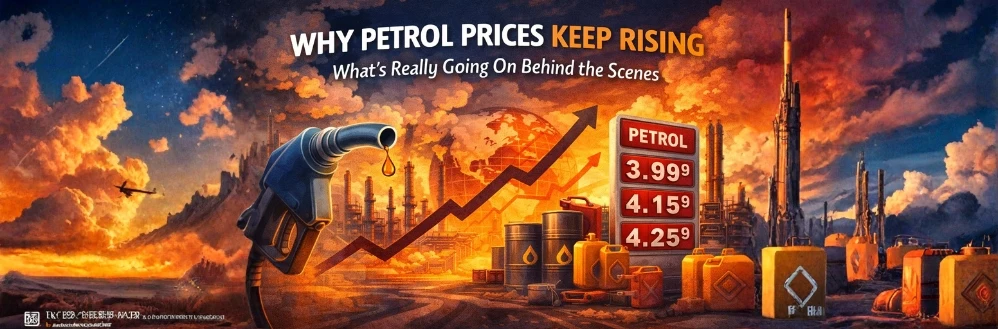
Every time petrol prices rise, it feels personal.
You notice it when you refill your tank, when cab fares increase or even when groceries quietly become more expensive. But here’s the thing – petrol prices don’t rise randomly. There’s always a story behind it and right now that story is unfolding on a global scale.
The World Runs on Oil (And India Imports Most of It)
India doesn’t produce enough crude oil to meet its needs. In fact, we import over 85% of our oil.
That means:
- When global oil prices rise ➡️ India pays more
- When India pays more ➡️ you pay more.
It’s that direct.
So if you ever wondered why something happening thousands of miles away affects your daily commute – this is why.
Wars and Conflicts: The Biggest Price Trigger
One of the main reasons petrol prices are rising right now is geopolitical tension, especially in oil-rich regions like the Middle East.
Here’s what happens:
- Conflicts create uncertainty
- Oil supply becomes unpredictable
- Markets panic
- Prices shoot up
| Interesting Fact 👀 Nearly 20% of the world’s oil passes through a narrow route called the Strait of Hormuz. If anything disrupts this route, the entire global oil supply chain gets shaken. |
Even the possibility of disruption is enough to increase prices.
Fear Has a Price: The “Risk Premium” Effect
This is where things get interesting.
Oil prices don’t just depend on actual shortages – they also depend on what people think might happen.
- Traders anticipate future problems
- They start buying oil early
- Prices rise in advance
This extra cost is called a risk premium.
In simple terms: You are not just paying for the petrol, you are paying for uncertainty.
The Dollar Game: Why Currency Matters
Oil is traded globally in US dollars.
So even if oil prices stay the same, you might still pay more if:
- The Indian rupee weakens
- It takes more rupees to buy the same amount of oil
It’s like paying extra just because of currency conversion.
Taxes: The Hidden Chunk in Your Fuel Bill
Here’s something most people don’t fully realize:
A significant portion of what you pay for petrol is tax.
- Central government taxes
- State government taxes
Together, they form a large part of the final price.
| Interesting fact 💡In many cases, taxes can make up nearly 50-60% of the petrol price in India. That means even if crude oil becomes cheaper, your petrol price may not drop proportionally. |
Why Prices Don’t Always Increase Immediately
You might notice that even when global oil prices rise sharply, petrol prices in India don’t always spike instantly.
That’s because:
- Oil companies sometimes absorb the cost temporarily.
- The government may delay price hikes for stability.
But this is not permanent.
Eventually, the gap catches up and prices adjust.
The Ripple Effect: Petrol Prices Affect Everything
Petrol isn’t just about vehicles.
When fuel prices rise:
- Transportation becomes expensive
- Food delivery costs increase
- Manufacturing and logistics costs go up
And slowly, silently – everything becomes more expensive.
That’s why fuel price hikes feel bigger than they look.
In Short, It’s Global Story with Local Impact
Petrol prices are not just about oil – they’re about politics, economics, psychology and global dependency.
From conflicts in distant regions to currency fluctuations and taxation policies, multiple layers come together to decide what you pay at the pump.
So the next time petrol prices rise, you’ll know – it’s not random.
It’s a chain reaction.
You don’t just pay for fuel. You pay for the world’s uncertainty, one litre at a time.
Read More : Why Is There an Uproar in the Middle East? And Why Is the USA Attacking?