
And why do they still matter….?!
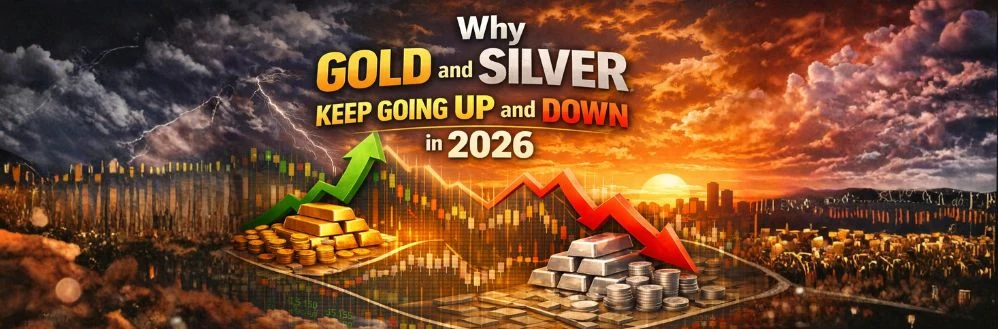
If you have checked gold and silver prices recently, you have probably noticed one thing – they don’t sit still. One day prices surge, the next day they dip. This constant movement often leaves people wondering: why does this happen, and why do these metals still matter so much?
In this blog, let’s understand what’s wrong with these precious elements?
Why Gold and Silver Prices Fluctuate so Often
Gold and silver prices move because they respond to global emotions as much as global economics. These metals react quickly to uncertainty, confidence and change.
- Global Uncertainty Drives Demand
Whenever the world feels unstable – wars, inflation, economic slowdowns or banking concerns – people turn to gold and silver. These metals are seen as safe-haven assets. When fear rises, demand rises and so do prices.
- Inflation and Interest Rates Impacts Metal Prices
When inflation increases, money loses value. Gold and silver don’t lose purchasing power in the same way, so people buy them to protect wealth. On the other hand, when interest rates rise, prices may dip because investors move money into interest-earning assets instead.
- Currency Strength Impacts Metal Prices
Gold and silver are traded globally in US dollars. When the dollar weakens, metal prices usually rise. When the dollar strengthens, prices often cool down.
- Demand from Jewellery, Industry, and Investment
Gold isn’t just jewellery – it’s also used in electronics, medicine and investment products.
Silver plays a massive role in solar panels, electric vehicles and medical equipment. Changes in industrial demand can push prices up or pull them down.
| Gold is so malleable that one gram can be stretched into a sheet the size of a tennis court |
Why Gold Remains Important (Even Today)
Gold has held value for thousands of years and that hasn’t changed in the modern world.
- It doesn’t rust, corrode or lose quality.
- Central banks still hold gold as a financial reserve
- It protects wealth during economic instability.
- It carries cultural, emotional and generational value.
In many households, gold isn’t just an investment – it’s security, tradition and legacy rolled into one.
| Fun Fact: All the gold every mined in the world could fit into three Olympic-sized swimming pools. |
Why Silver Is More Than “Affordable Gold”
Silver often gets less attention, but it’s incredibly powerful:
- It’s one of the best electrical conductors in the world.
- Essential for renewable energy and modern technology
- Used heavily in solar panels and electric vehicles
- Plays a key role in medical and antibacterial applications
Because silver sits at the intersection of investment and industry, its price reacts faster to economic shifts – making it more volatile, but also more dynamic.
| Fun Fact Silver reflects light better than any other metal and ancient civilizations used silver to keep water fresh – long before modern science explained why. |
Why Prices Feel Extra Unstable Right Now
Today’s world moves fast – news spreads instantly, markets react within seconds and global events overlap constantly. This creates sharper price movements than before.
And rising inflation, geopolitical tensions, changing interest rates and growing industrial demand and you get the constant up and down movement we’re seeing now.
| Gold is edible and often used in luxury desserts (yes, really!) |
Should Price Fluctuations Worry You?
Not necessarily.
Gold and silver work best when viewed long-term, not day-to-day. Short-term price changes are normal. Their real value lies in stability over time, protection against uncertainty and usefulness beyond just numbers on a chart.
Bottomline
Gold and silver aren’t just commodities – they are emotional assets, economic protectors and industrial essentials. Their prices move because the world moves. And as long as uncertainty, innovation and human value systems exist, these metals will continue to matter.
Understanding why prices fluctuate helps remove fear and replaces it with clarity.