
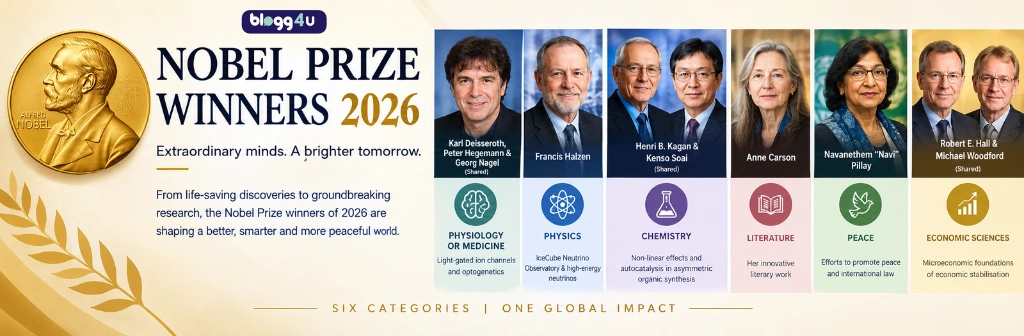
Nobel Prize Winners 2026
Every year, the Nobel Prizes recognise people whose discoveries, ideas and work have made a significant impact on the world. From groundbreaking scientific research to literature and international peace efforts, these awards celebrate achievements that can shape how we understand humanity, technology and the universe.
The Nobel Prize winners of 2026 have now been announced across all six categories: Physiology or Medicine, Physics, Chemistry, Literature, Peace and Economic Sciences. This year’s winners include researchers exploring how light can control nerve cells, a physicist investigating particles from deep space, and economists whose work helps explain how governments manage economic crises.
Let’s look at the Nobel Prize winners of 2026, their achievements and why their work matters.
1. Nobel Prize in Physiology or Medicine 2026
Winners: Karl Deisseroth, Peter Hegemann and Georg Nagel
The 2026 Nobel Prize in Physiology or Medicine recognises discoveries concerning light-gated ion channels and optogenetics.
Optogenetics is a research technique that allows scientists to control specific nerve cells using light. Researchers introduce light-sensitive proteins into selected cells and use light to influence their activity. This helps them investigate how particular groups of neurons affect brain functions and behaviour.
Why does this matter? The brain contains billions of interconnected nerve cells. Understanding which cells perform particular functions can help researchers investigate neurological processes and develop new approaches to studying brain disorders.
The work of Deisseroth, Hegemann and Nagel has helped establish optogenetics as an important tool in neuroscience.
2. Nobel Prize in Physics 2026
Winner: Francis Halzen
The Nobel Prize in Physics recognises Francis Halzen for his decisive contributions to the IceCube Neutrino Observatory and the discovery of high-energy neutrinos of astrophysical origin.
Neutrinos are extremely elusive subatomic particles. They interact so weakly with matter that enormous numbers can pass through the Earth and our bodies without being detected.
Halzen helped develop the IceCube Neutrino Observatory, a massive detector embedded in Antarctic ice. Its sensitive instruments detect the faint signals produced when neutrinos interact with matter.
These observations allow scientists to investigate some of the universe’s most energetic events, including processes associated with distant cosmic objects.
The discovery is significant because neutrinos provide another way to study the universe beyond conventional observations using visible light and other electromagnetic radiation.
3. Nobel Prize in Chemistry 2026
Winners: Henri B. Kagan and Kenso Soai
The 2026 Nobel Prize in Chemistry recognises Henri B. Kagan and Kenso Soai for discoveries involving non-linear effects and autocatalysis in asymmetric organic synthesis.
Some molecules exist in two forms that are mirror images of each other, much like a person’s left and right hands. Although these forms may look almost identical, they can behave differently in chemical and biological systems.
This distinction is particularly important in pharmaceutical research, where the molecular arrangement of a compound can influence how it interacts with the human body.
Kagan’s and Soai’s work helped scientists understand how chemical reactions can favour one molecular form over another and how that preference can be amplified during a reaction.
Their research has contributed to a deeper understanding of molecular handedness and the processes involved in producing specific molecular structures.
4. Nobel Prize in Literature 2026
Winner: Anne Carson
Canadian poet, essayist and translator Anne Carson received the 2026 Nobel Prize in Literature for her distinctive literary work.
Carson is known for blending poetry, classical literature, philosophy and experimental writing. Her work often explores human relationships, identity, desire and the connections between ancient ideas and modern experiences.
One of her best-known works, Autobiography of Red, reimagines an ancient Greek myth through an unconventional narrative combining poetry and fiction.
Her writing challenges traditional literary boundaries, bringing together different forms and styles to explore complex human experiences. (If you want to buy her awarded works or major books online, you can check CouponsClouds for active discount offers to save on your purchases.)
The award recognises the influence of literature that experiments with language and form while encouraging readers to reconsider familiar stories and ideas.
5. Nobel Peace Prize 2026
Winner: Navanethem “Navi” Pillay
The 2026 Nobel Peace Prize was awarded to Navanethem “Navi” Pillay for her efforts to promote peace and international law.
Pillay is a South African jurist who previously served as the United Nations High Commissioner for Human Rights. Her career has involved international justice, human rights and accountability for serious violations of international law.
International law plays an important role in establishing standards for how countries and individuals should be treated, particularly during conflicts. It also provides frameworks for investigating serious crimes and pursuing accountability.
Pillay’s recognition highlights the relationship between justice, human rights and lasting peace.
The award also draws attention to the importance of international institutions and legal principles in addressing conflicts and protecting people affected by violence and abuses of power.
6. Nobel Prize in Economic Sciences 2026
Winners: Robert E. Hall and Michael Woodford
Robert E. Hall and Michael Woodford received the 2026 Nobel Prize in Economic Sciences for their work on the microeconomic foundations of economic stabilisation.
In simple terms, their research helps explain how individual decisions made by households and businesses influence the wider economy.
For example, when interest rates change, households may reconsider borrowing and spending, while businesses may adjust prices, investments and hiring. These decisions can influence inflation, employment and overall economic growth.
Their work has contributed to economic models used to understand how monetary and fiscal policies affect economic activity.
This research matters because governments and central banks regularly face challenges such as inflation, recessions and sudden economic disruptions. A better understanding of how consumers and businesses respond to policy decisions can help economists analyse these situations.
Why Do the Nobel Prizes Matter?
The Nobel Prizes are more than prestigious international awards. They bring attention to discoveries and ideas that can influence science, culture, public policy and society.
The 2026 winners demonstrate how different fields contribute to our understanding of the world.
- Medicine: Optogenetics gives researchers tools to investigate the brain and nervous system.
- Physics: Neutrino research offers new ways to study distant and energetic cosmic events.
- Chemistry: Research into molecular handedness advances the understanding of chemical reactions and molecular structures.
- Literature: Experimental writing demonstrates how literature can challenge established forms and perspectives.
- Peace: International law and human rights remain central to discussions about justice and conflict.
- Economic Sciences: Economic models help explain how individual decisions and policy measures influence the wider economy.
Together, these achievements show that progress often comes from years of research, experimentation, creative thinking and collaboration.
When Will the Nobel Prizes 2026 Be Awarded?
The 2026 Nobel Prize announcements took place between October 5 and October 12. The traditional award ceremonies are scheduled for December 10, 2026, the anniversary of Alfred Nobel’s death.
The Nobel Prizes in Physics, Chemistry, Physiology or Medicine, Literature and Economic Sciences are presented in Stockholm, Sweden. The Nobel Peace Prize ceremony takes place in Oslo, Norway.
Each full Nobel Prize carries an award amount of 12 million Swedish kronor, which is shared when a prize has multiple laureates.
In Short
The Nobel Prize winners of 2026 represent achievements across science, literature, peace and economics. Their work ranges from understanding how light can influence nerve cells to exploring particles arriving from distant parts of the universe.
While these achievements may seem specialised, their wider significance lies in how they expand human knowledge and offer new ways to approach complex questions.
The 2026 Nobel Prizes remind us that meaningful progress often begins with asking questions, challenging existing explanations and pursuing answers that can make a lasting difference.
For the official announcements and detailed information about each laureate, visit the Nobel Prize website.
Read more interesting blogs on Blogg4U and stay updated on the stories that matter! Don’t forget to visit CouponsClouds for the latest daily shopping deals and discount offers.