
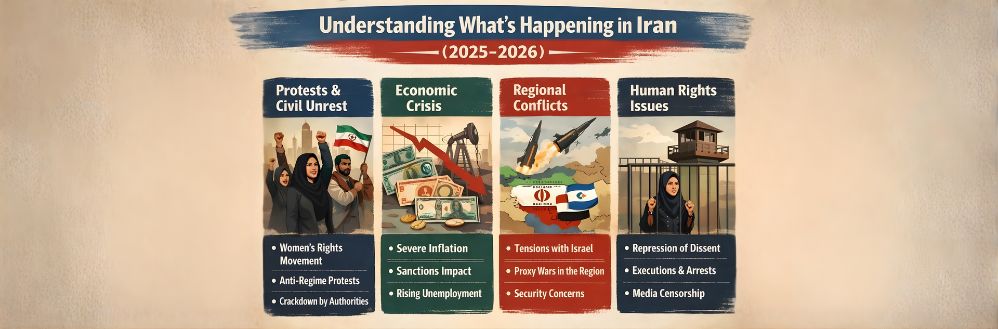
A clear, grounded explanation of the protests, their causes and why the situation matters to the world (Iran).
- What’s Happening Right Now?
Nationwide Protests and Crackdowns
Since late December 2025, Iran has been engulfed in one the largest waves of protests in decades. People across all 31 provinces have taken to the streets – in Tehran, Isfahan, Shiraz, Mashhad and many other cities, demanding change.
Scope and Scale
- Tens of thousands of people have been arrested amid the unrest.
- Independent monitoring groups estimate the death toll in the thousands – making this possibly the deadliest crackdown in modern Iranian history.
- The Iranian government has widely cut internet and phone access to restrict information and organizing online.
Harsh Repression
Iran’s authorities have responded with intense force:
- Security forces have fired on crowds.
- Mass detentions are ongoing.
- Some protesters have been fast-tracked for trial, with at least one facing the death penalty.
Communication Blackout
The government has largely cut off internet access the country – a tactic similar to previous crackdowns – making it hard to understand events in real time from inside Iran.
- What Triggered the Protests? (Root Causes)
A Deep Economic Crisis
At its core, this wave of unrest was triggered by severe economic collapse:
- The Iranian currency (the rial) has fallen dramatically – losing most of its value in recent years.
- Inflation has cored, with food and essential goods becoming unaffordable.
- Many Iranians struggle to afford basics like bread, medicine, electricity, fuel and water.
Sanctions and War Pressures
Iran’s economy has been squeezed by international sanctions – especially related to its nuclear program and by military tensions in the region, including a 12-day conflict with Israel in 2025.
Strike Began at the Grand Bazaar
The protests began with strikes and demonstrations by merchants in Tehran’s historic Grand Bazaar. A symbolic and economic heart of the country. From there, the movement spread quickly nationwide.
- Why the Protests Escalated So Fast
Initially, the unrest was about prices, jobs, and savings. But very quickly:
Political Demands Grew
People began to shout slogans like “Death to Khamenei”, directly challenging the Supreme Leader and the entire political system.
Loss of Trust
The protests reflect a deeper collapse of trust between ordinary people and Iran’s ruling establishment. Many feel the government prioritises military spending and foreign policy over their daily survival.
- How This Fits into Iran’s Recent History
Iran has seen several cycles of unrest since the 1979 Islamic Revolution, when a monarchy was replaced by the current Islamic Republic.
| What was the 1979 Islamic Revolution?The 1979 Islamic Revolution was a popular uprising in Iran that overthrew the Shah, Mohammad Reza Pahlavi, an authoritarian, Western-backed ruler accused of corruption, inequality, and repression. Led by exiled cleric Ayatollah Ruhollah Khomeini, millions of Iranians from different social groups protested for justice and dignity, forcing the Shah to flee in January 1979. Khomeini returned soon after, and a referendum replaced the monarchy with an Islamic Republic, where ultimate power rests with a religious Supreme Leader rather than elected officials. The new system imposed Islamic law, restricted political freedoms, enforced strict social controls (especially on women), and adopted a strongly anti-Western stance. While the revolution promised freedom and equality, it resulted in a tightly controlled theocratic state that continues to shape Iran’s politics and ongoing unrest today. |
Key Recent Movements:
- 2009 “Green Movement” – nationwide protests after disputed elections.
- 2019 fuel price protests – sparked by shock subsidy cuts.
- 2022 “Woman, Life, Freedom” – ignited after the death of Mahsa Amini in morality police custody, focusing on women’s rights and freedoms.
- 2025-2026 wave – began over economic collapse but quickly became border, politically charged unrest.
Each time, the protests reflected deep frustrations with economic hardship and political repression but this latest wave is marked by a far more brutal response and widespread social participation.
- What Are People Demanding?
While early protest chants focused on:
- Economic relief (jobs, prices, currency stability),
The movement soon included broader political demands such as:
- Greater freedoms
- An end to corruption
- Limits on clerical power
- Even systemic change or regime collapse
- What Is the Government Saying?
Iran’s leadership frames the protests as:
- Foreign-paid disruption
- Terrorist or criminal acts
- Threats to national stability
They’ve justified forceful suppression and are pushing trials for arrested protesters.
- International Reactions
Governments and human rights organizations worldwide have condemned the violence. The U.S. and others have warned Tehran against executions and brutality. But there’s also concern about escalation between Iran and other nations, including the U.S. and Israel.
- What Happens Next?
No one can predict exactly how this will end. Several possibilities include:
- Protests continue, intensifying pressure on the government
- More crackdowns and repression
- Potential negotiations or limited reforms
- International consequences if violence escalates further
What’s clear is that this moment represents one of the most significant challenges to Iran’s government in decades.
In Short
This is not “just economic unrest.” It is a complex sociopolitical movement fueled by decades of economic hardship, rising costs of living, limited freedoms and deep distrust of the ruling system. Its impacts will be felt not only inside Iran but across regional and global politics – especially given ongoing tensions over nuclear programs and U.S. involvement.
Read More : New Year Resolutions 2026 explained, plus realistic tips to help you stay on track and turn intentions into lasting habits.